
Have you ever begun reading a piece, and in a moment - one simple, non-consequential moment - you are whisked off onto a train of thought, but it is continuously running alongside the train where you are still actively reading, keeping pace, never challenging your present train, and slowly you begin to hope your present train gets to the station soon so you can continue on in the new train?
If that makes any sense!?!
Yesterday I picked up and read Jerome K Jerome’s short story, A Ghost Story. I had previously enjoyed Jerome's comedic romp up and down the Thames in Three Men in a Boat (To Say Nothing of the Dog) with its classic British humor, the dog, and the narrative of the Thames - it had all made me pine for my summer spent along The Backs in Cambridge years ago.
However, unfortunately for Jerome K. Jerome and A Ghost Story, he mentioned Charing Cross far too early in his little work, first paragraph in fact! Off my mind went on a train ride to New York City, to the apartment of Helen Hanff and to the bookshop at 84 Charing Cross Road.


Helene Hanff’s 84 Charing Cross Road takes the reader into the business and personal correspondence between a bookseller in London and a reader and writer in New York. I was familiar with the setup of the story having seen the 1987 movie many years before, starring Anthony Hopkins and Anne Bancroft. Arguably, the movie does an excellent job capturing the essence of the content of the correspondence and relationship between these two worlds separated by an ocean. But what the novella brings to the reader, that the movie simply can’t do, due to time and the lack of reader intimacy, is the further nuances of the relationships and the small little anthropological treasures revealed in the correspondence.
The endearing quality of Hanff’s book is that it is made up of letters that weren’t written to be published, they were merely outcomes of business at first and of care as the years progressed. Of course, letters written by a quick witted New York writer naturally will be rich with expressive energy and ebullient descriptions.
While Helene Hanff can’t help but be her exuberant self, quite early on introducing familiarities and American “can do” energy in her letters, Frank Doel, the bookseller, maintains his business professionalism and classic British steadfast persona until given the opportunity to finally write a personal note of thanks and share the latest news on the cast of “characters” in the bookshop. It only took him three years!
Correspondences then follow from other members of the bookshop and personal letters from Frank’s wife of thanks and invitation to visit them. Letters about the old-woman neighbor and her linen embroidery, the passing of the longest serving employee of Marks and Co, young women shop girls getting married and updates on the realities of aging and family. It’s all just rolling along quite smoothly, even with the interruptions of bumps and wiggles with repeatedly delayed travel plans to England and Hanff’s career highs and lows, Doel’s children growing up, even the bookseller world changing. And like a a sudden emergency stop - squealing wheels, burnt metal, luggage flying - a letter arrives about Doel’s passing, from Marks and Co’s secretary:
It ends. -where the correspondence began, in formal cold language of business, Helene receives her final letter from the offices of the bookseller, Marks and Co., where her friend, “the blessed man” Frank Doel presided for forty years and twenty of them were spent in selling books to Helene Hanff in New York City.
Fortunately for Helene, and the reader, one more letter from England arrives, from Frank’s widow.
So why did my mind immediately hop onto a train to Charing Cross when I read those words in a ghost story? Because of humanity! 84 Charing Cross Road is evidence of people sharing love - over books, living conditions, health, well-being, humor. I get a little choked up even now just revisiting these last moments.
As much as 84 Charing Cross Road is about two separate worlds meeting over the love of beautiful old books, Hanff’s own story of her writing career and successes and failures is ever present in the background. She’s a single woman, self-educated, enthusiastic for the best in thought and writing, not because it’s a bestseller and others say it’s the best, but because there really is an ethereal standard of “the best” out in the world that she grabs onto and choses to define her home, friends and bookshelves by.
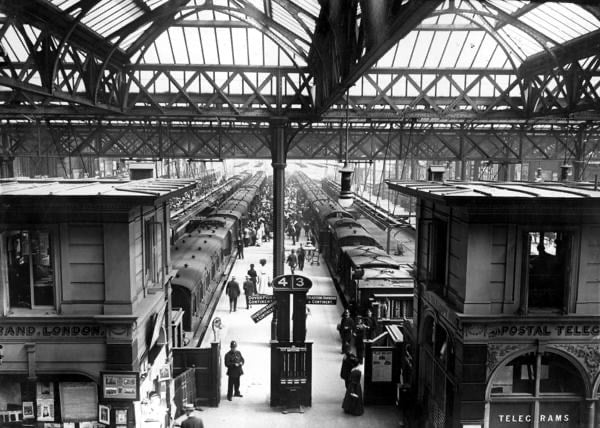
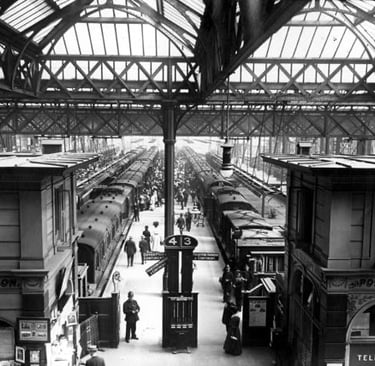
Interior Of Charing Cross Station, London, Circa 1890
Getting back to that original train that I was on - you know the ghost story one - well it did make it to the station quite quickly, fortunately! It was an okay story, nothing to write home about. I still think Three Men and a Boat is better!
But I am glad that picking up and reading Jerome’s story did spark a memory and that I was able to hop onto the train and ride it to Charing Cross and revisit the souls that shared a love for books and the words within them and witness the kindness of mankind.
84 Charing Cross Road is a great read, the pure thoughtfulness and respect for mankind found among the words and letters between a New York writer and a London bookseller will undoubtedly touch your own heart.
And a bonus for those of us who spend hours in the back stacks of used book stores hoping to find a jewel, 84 Charing Cross Road is sprinkled with all kinds of book loving moments that are a real treat to read!
Many thanks for reading and spending a bit of time with me today. I hope you get the chance to pick up Hanff’s book if you haven’t read it already. And even if you have, maybe think about taking it on a train ride for another read!
Brittany