**If you are on a mobile device, click the button below to read the full blog post in a web browser.
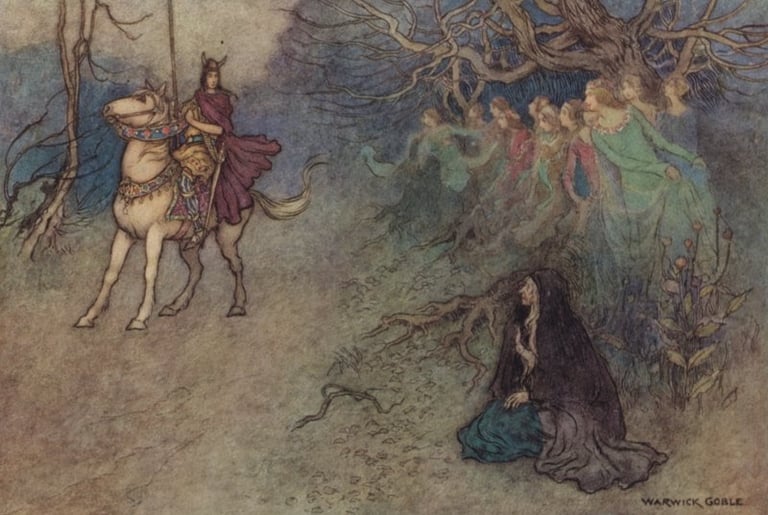
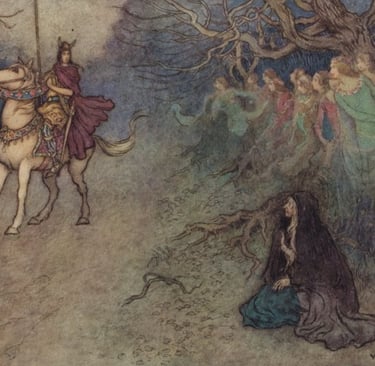
The Wife of Bath's Tale, Warwick Goble, 1912, for a collection of Chaucer's poetry.
After recently reading “The Wife of Bath’s Tale”, I thought to myself, did I just read the ultimate answer to the conflict that afflicts every marriage? Or was I just convinced that Chaucer’s answer is true because he spun a tale filled with humor and piety? While all in a swirling haze, where it finally settled didn’t matter because it felt more secure than not having an answer?
Chaucer, through his arrogant little knight, who needs to learn some manners!, provides an answer to the age-old question - what do women want? The answer came in the form of an ugly hag, a woman neither drawing admiration nor pity. A nobody in the eyes of those who make choices informed by desire and not a noble heart.
So what did this knight learn?
The crowd is silent, in agreement, no woman may disagree? Is the secret out of the bag? Have our inner demands been disclosed? How do we possibly go forward in a world where our “secret” is public?
“Women wish to have complete control over both their husbands and love-affairs, and to be masters of their men.”
-Canterbury Tales, “The Wife of Bath’s Tale”
Well of course that isn’t the actual secret desire of every woman. It may make for hilarious plot and writing, and it may even be a joke among long married women, but I don’t think it really rings true.
Chaucer gives us a female tale-teller, a grotesque arrogant, five times married woman who is the antithesis of any healthy, functioning female - the exact image of what men who want to say all women are - evil self-satisfying whores - and will love to read about.
And brilliantly and conversely to her own nature, the tale she then tells, “The Wife of Bath’s Tale”, is filled with piety, honor and true goodness that disappointedly diminishes into a stereotype of men and women that, until I read this tale this week, is as old a stereotype as Chaucer. Really!?! I mean the Bible is leading the way on painting some really great and some really horrible women as well, so Chaucer I’m not sure you were that original and I find more lessons learned in that Great Book than in yours!
In our current age when “hyper-masculitniy” and “toxic alpha male” is promoted to young men in “shorts” on the internet and in programs leading to potential financial success, it is easy to see how the dysfunctional, but admittedly humorous portrayal of women’s needs, is an easy avenue to securing the male-ego and creating division among not only men but women as well.
What I hoped for Chaucer’s tale was a real reckoning, but with some humor of course.
Unfortunately, this tale reads more like a bad movie from the ‘90s or early ‘Naughts. “What Women Want” with Helen Hunt comes to mind. Fake female empowerment, but really just surface respect, nothing more, and a little slapstick humor to lighten the load.
Admittedly, even as I write this piece I am surprised by my “harsh” criticism of this little tale from Chaucer. I love a good joke, I’ll throw a one-liner out like anyone else who has gone into the trenches of marriage and come out the other side with all my arms and legs intact. But maybe that’s also why I’m so critical. Chaucer attempts to minimize the sacred relationship of man and wife - to a joke, and it isn’t even a good one!
Chaucer plays more like a cheap, baudy, stand-up on the outskirt comedy circuit, playing at strip-clubs and whore houses. Maybe even a bit of my “whatever Chaucer” mood is because it isn’t really very good comedy writing. The jokes are stale and there are real victims in his comedy.
To pump up his credibility, Chaucer has the gaul to mention a couple of the greats, Seneca and Boethuis:
Awesome! Surely through comedy and brilliance Chaucer is going to utilize these amazing stoics to justify why the “noble” knight confidently chooses the ugly faithful wife!? - but alas, dear reader, no, he does not! Chaucer reduces his “noble” knight to pass the choice of whether wifely faithfulness is better than good looks to his wife!?! Yuck! Yeah, let’s let her take on even more mental load for her man! And then has her “giddy” with satisfaction in winning control over her husband!
The piece constantly weaves in and out of this narrative and lands - Plop! - right in the pile of horse manure that it was born out of.
“…there you’ll find it plainly stated that there is no doubt that the man is noble who does noble deeds.”
- Canterbury Tales, “The Wife of Bath’s Tale”
It is only fair of me to offer my two-cents on what women really desire. And after too many decades witnessing the good and the bad of what a union of a man and woman can look like, I think I have figured it out - at least for me!
I humbly offer that “what women desire most” is - INTEGRITY. It comes in all kinds of wrappings, with all sorts of different bows, but a woman knows when she has found it in a man and it is more precious than the rarest jewels in the world.
Thanks for reading this week’s Thursday Reflection and spending a bit of your day with me, Chaucer and the age-old question of “what women desire most”.
Brittany